

Tissue Culture & Genetic Integrity
The cannabis industry is evolving, and so are we.
As scientific research around plant health and genetic integrity expands, we believe the standard for our nursery must rise with it. That’s why we’ve built a full-scale, in-house tissue culture laboratory.
This is a strategic investment in the long-term strength of our genetics. By working at the cellular level through meristem propagation and structured HLVd screening, we are strengthening the foundation of every strain in our nursery.
By integrating tissue culture directly into our production pipeline, we are creating cleaner mother stock, tighter pathogen oversight, and greater consistency across all cultivars.
This is what it takes to operate as a serious, forward-thinking nursery. Sun-Clone.com is committed to setting that standard.
Built In-House. Built for Clean Plants. Built for the Long Term.
Tissue culture is not a short-term program. This is not something we are doing temporarily to address a single issue. It is now permanently built into how we operate. All future mother plants will originate from tissue culture. Testing and culture regeneration will continue on a rolling schedule. This is now part of our long-term infrastructure.
Our in-house tissue culture laboratory allows us to propagate plants at the cellular level. Instead of taking large cuttings from mature plants, we start with microscopic pieces of the plant’s youngest tissue.
Plants have an area at the very tip of their shoots called the meristem. These are the newest, fastest dividing cells in the plant. Because they are so young and have not fully developed vascular tissue, they are the least likely area to carry systemic pathogens like Hop Latent Viroid.
By isolating the meristem and placing it into sterile conditions, we can regenerate an entirely new plant from that small piece of clean tissue.
Regenerating mother plants from tissue culture prevents the accumulation of stress and latent pathogens from being passed on to future generations of mothers. It is also more rigorous than surface-level testing, where you sample a leaf from a large, mature plant and test only that one piece.
With tissue culture, we:
-
Start with the cleanest possible part of the plant
-
Grow it in a sealed, sterile environment
-
Test it before it is expanded
-
Then scale it into production
We rebuild cultivars from their cleanest cellular starting point and verify them through structured testing.
This approach allows us to:
-
Reset and preserve elite genetics
-
Reduce pathogen pressure before plants enter production
-
Integrate structured HLVd screening at the earliest stage
-
Maintain tighter control over long-term mother plant health
-
Standardize quality across every cultivar in our nursery
As we transition all strains to tissue culture–derived mother stock, we are strengthening the biological foundation of our nursery. This ensures that the clones we provide are backed by science, not assumptions.
Clean plants are not created by chance.
They are the result of systems, discipline, and long-term investment.
A Look into the
Sun-Clone Lab
From Propagation Room to Tissue Culture Laboratory
When we decided to build our tissue culture lab, we started with a working propagation container — a Conex box that had already been retrofitted for clone production.
It was insulated. It had shelving for rooted plants. It had lighting, heat, exhaust, and dehumidification. It was functional and controlled — but it was designed for traditional propagation, not sterile lab work.
Tissue culture requires something different. It requires surgical-level cleanliness, environmental stability, and workflow separation. So the first step wasn’t adding equipment.
It was subtracting everything.

Resetting the Space
We relocated our propagation operations to a new facility, completely emptying the container.
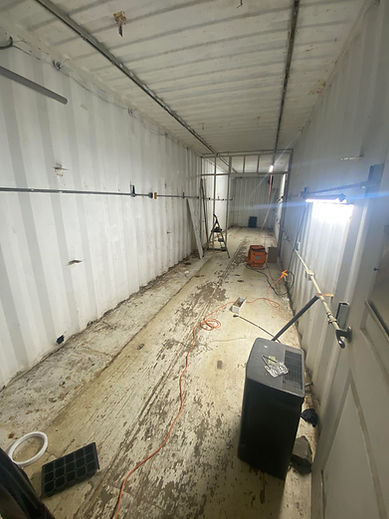
Once cleared, we treated the container like a clean-room project. Every surface was bleached from top to bottom to remove any lingering biological contaminants from its prior life as a propagation room.
From there, we rebuilt the space with stability in mind.
We added exterior insulation to regulate temperature swings. We installed both hot and cold water lines to support proper sanitation protocols. We rewired the electrical system to safely power specialized lab equipment.
Finally, we coated the interior in bright white, non-porous paint. White surfaces increase light reflection, improve visibility during sterile work, and make contamination easier to detect.
At this stage, the container was no longer a grow room. It was becoming a laboratory shell.
Engineering Clean Zones
We installed HEPA air filtration to reduce airborne particulates and maintain controlled airflow. Then we divided the interior into three separate clean zones using sliding glass doors. Each zone creates a progression — from general lab space to increasingly sterile environments.
In tissue culture, contamination often comes from movement: people, air, or improperly staged materials. By creating physical divisions, we reduced the risk of cross-contamination and established defined sterile boundaries.
Inside these zones, we installed stainless steel benches and shelving. Stainless steel is non-porous and easy to sanitize
.
Three sinks were added to support proper workflow separation. In sterile lab environments, task separation is critical.
Then came the core equipment:
-
A laminar flow hood
-
An autoclave
-
A sanitizing dishwasher
-
Dedicated heaters and lighting
At this point, the physical lab was complete. But building the room is only half the process.

Initiating Cultures
We began bringing in meristem samples — tiny pieces of the youngest growing tissue from selected plants.
These samples were surface-sterilized and placed into sterile nutrient media inside sealed culture vessels. The media provides sugars, hormones, and nutrients that allow the tissue to regenerate into a complete plant.
Tissue culture is precise. Hormone concentrations must be balanced. Even slight variations can lead to browning, contamination, or stalled growth.
For the first several months, we monitored cultures daily. Many samples yellowed or browned. Some failed entirely. This is part of the process.
When working with living cells in a sterile environment, dialing in media composition, light intensity, and sterilization protocols takes refinement. We adjusted nutrient ratios. We fine-tuned environmental conditions. We improved handling efficiency under the laminar hood.
Multiple meristem cultures were initiated for every cultivar, creating redundancy in case any individual culture failed.

Regeneration
Then we began to see it — callus formation, new growth, and finally, roots.
Healthy white roots forming inside sterile media are a major milestone. It means the tissue has successfully regenerated and established itself as a viable plantlet.
Once root systems were stable, plantlets were carefully removed from their culture vessels and transferred into peat pellets. This step is known as acclimatization — transitioning plants from sterile lab conditions to a natural growing environment.
In culture vessels, humidity is near 100% and contamination risk is controlled. Gradual acclimation allows roots and foliage to strengthen before entering standard nursery conditions.
At this stage, tissue samples are collected for HLVd testing. Because these plants originated from isolated meristem tissue and were grown under sterile conditions, the test results directly reflect the integrity of the regenerated line.
This is where laboratory science intersects with production agriculture.

Why This Approach Is Different — and Why It Matters
Distribution of pathogens within a mature plant can vary, and by the time a plant reaches full production size, it has already been exposed to environmental handling, mechanical stress, and potential cross-contamination.
Our approach flips that model.
Instead of testing large plants after expansion, we regenerate the plant from its youngest meristem tissue and test it before it becomes a production mother.
Here’s why that matters:
-
We test earlier. Cultures are screened before they are scaled into mother rooms.
-
We test cleaner material. Meristem tissue is the least likely area of the plant to carry systemic pathogens.
-
We test identical material. When a culture is split, one portion is tested while its genetically identical counterpart continues growing. The result directly reflects the plant that remains.
-
We reduce spread risk. If a culture fails testing, it is eliminated before ever entering the nursery production environment.
Rather than asking, “Is this large plant clean?” we ask, “Is this genetic line clean at its foundation?”
By combining tissue culture regeneration with structured HLVd screening, we are not simply detecting problems — we are preventing them from scaling.
Every mother plant that originates from this system carries documented lineage, controlled handling history, and confirmed testing results before it produces clones.
